
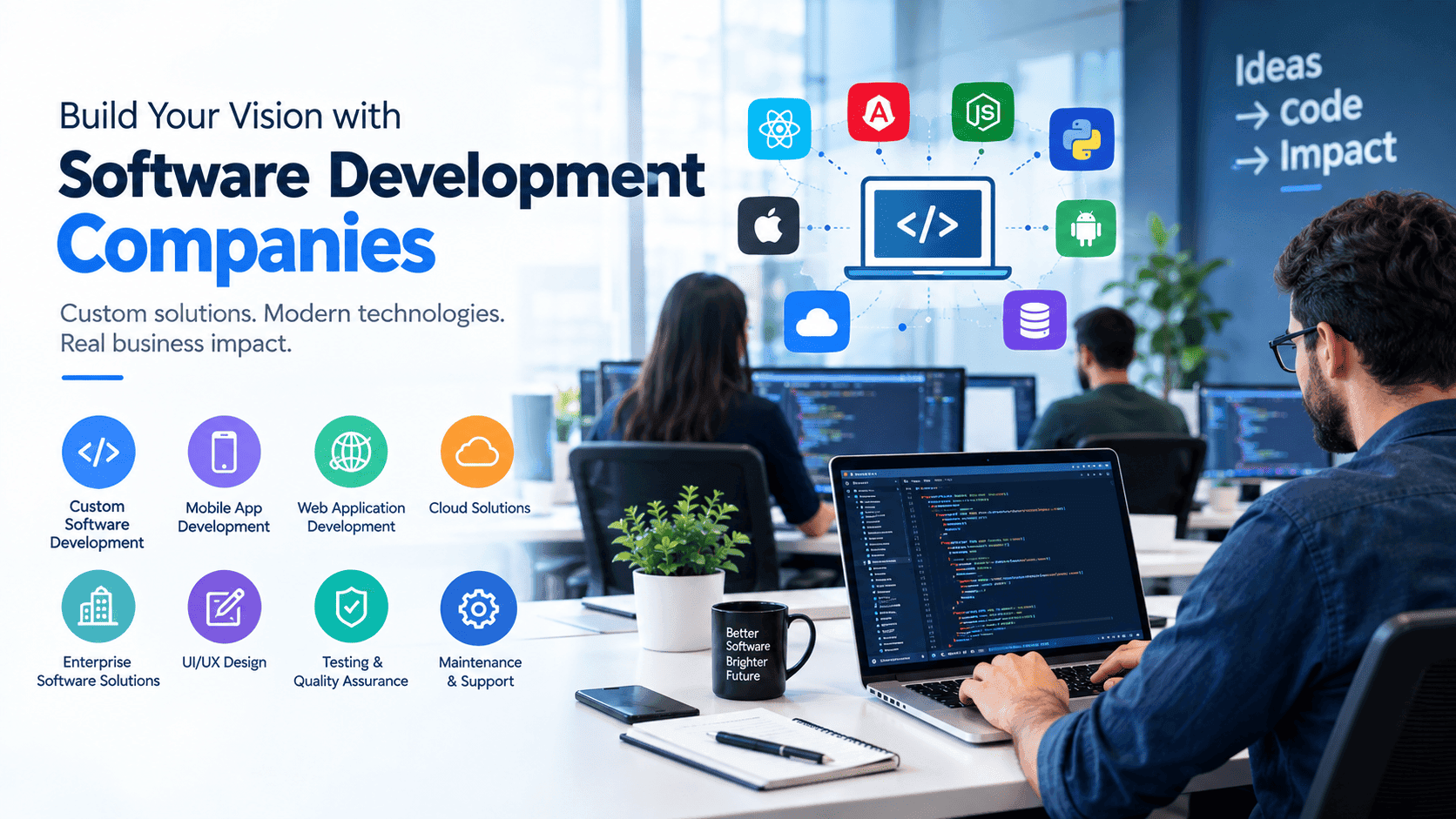
In today’s digital world, software has become an essential part of almost every business. Companies use software to manage operations, communicate with customers, automate repetitive tasks, analyze data, and deliver digital products and services. As businesses continue to adopt digital technologies, the demand for professional software development companies is growing rapidly.
A reliable software development company can help businesses transform ideas into functional, secure, scalable, and user-friendly software solutions. Whether you need a mobile application, web application, enterprise software, cloud platform, or custom business solution, choosing the right development partner can have a major impact on the success of your project.
What Are Software Development Companies?
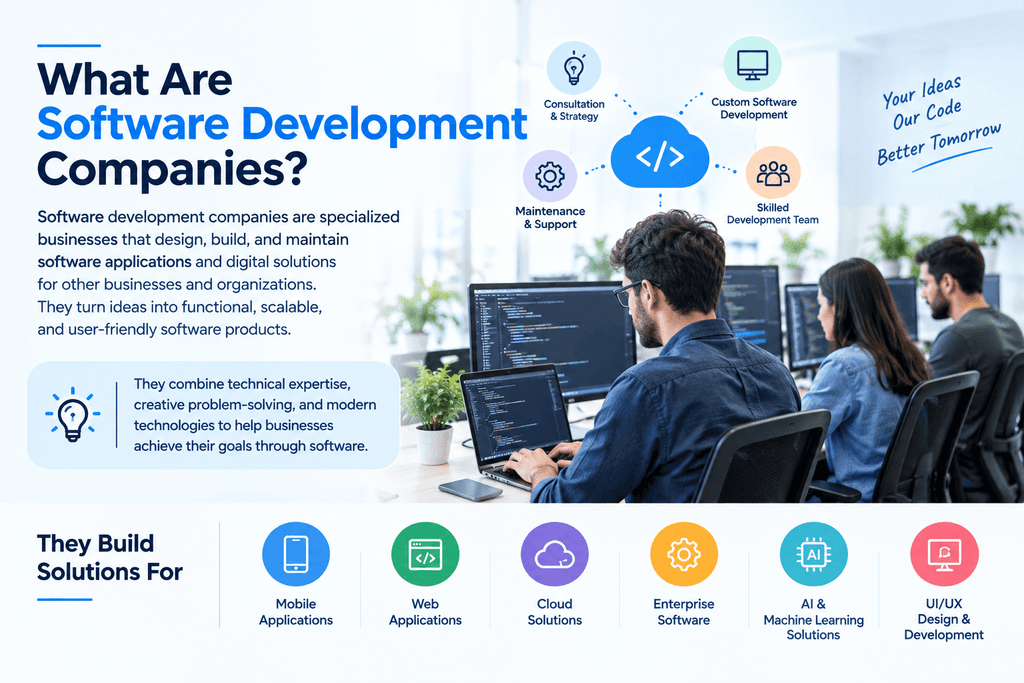
Software development companies are organizations that specialize in designing, developing, testing, deploying, and maintaining software applications and digital solutions.
These companies work with startups, small businesses, enterprises, healthcare organizations, financial institutions, retailers, educational institutions, and many other industries.
A software development company may offer services such as:
- Custom software development
- Web application development
- Mobile app development
- Enterprise software development
- Cloud application development
- UI/UX design
- Software testing
- API development
- Software maintenance
- Software consulting
- Artificial intelligence development
- Machine learning solutions
- DevOps services
- Database development
- Software integration
The exact services depend on the company’s expertise, technology stack, industry experience, and development capabilities.
Why Do Businesses Need Software Development Companies?

Developing high-quality software requires technical knowledge, planning, design, testing, and ongoing maintenance. Many businesses do not have an internal team with all the necessary skills to manage a complete software project.
Working with a professional software development company allows organizations to access experienced developers, designers, project managers, quality assurance specialists, and technology consultants.
For example, a company may have an idea for a customer-facing mobile application but lack the technical expertise to build it. A development partner can transform that idea into a complete application, from initial planning and UI/UX design to development, testing, deployment, and maintenance.
Types of Software Development Companies

Software development companies can specialize in different areas depending on their expertise and target markets.
Custom Software Development Companies
Custom software development companies create solutions specifically for individual businesses. These applications are designed according to the client’s requirements rather than using a generic software package.
Custom development is useful when a business needs unique workflows, specialized features, integrations, or scalability.
Mobile App Development Companies
Mobile app development companies focus on creating applications for smartphones and tablets.
They may develop applications for platforms such as Android and iOS, as well as cross-platform applications that work across multiple devices.
Mobile applications can be developed for industries including healthcare, education, e-commerce, finance, transportation, entertainment, and fitness.
Web Development Companies
Web development companies specialize in websites and web-based applications. Their services may include frontend development, backend development, database development, API integration, and cloud deployment.
Modern web applications can provide functionality similar to traditional desktop software while allowing users to access services through a browser.
Enterprise Software Development Companies
Enterprise software companies develop large-scale applications for organizations with complex business processes.
Enterprise solutions may include customer relationship management systems, enterprise resource planning platforms, inventory systems, human resource software, financial systems, and business intelligence platforms.
Healthcare Software Development Companies
Healthcare software development companies create digital solutions for hospitals, clinics, laboratories, pharmacies, healthcare startups, and medical professionals.
Their services may include electronic health record systems, telemedicine platforms, appointment management software, patient portals, healthcare mobile apps, and medical management solutions.
FinTech Software Development Companies
FinTech development companies specialize in software for financial services.
They may develop payment applications, banking platforms, financial management tools, investment applications, insurance software, and other financial technology solutions.
Security, privacy, regulatory requirements, and reliable transaction processing are particularly important in financial software.
Services Offered by Software Development Companies
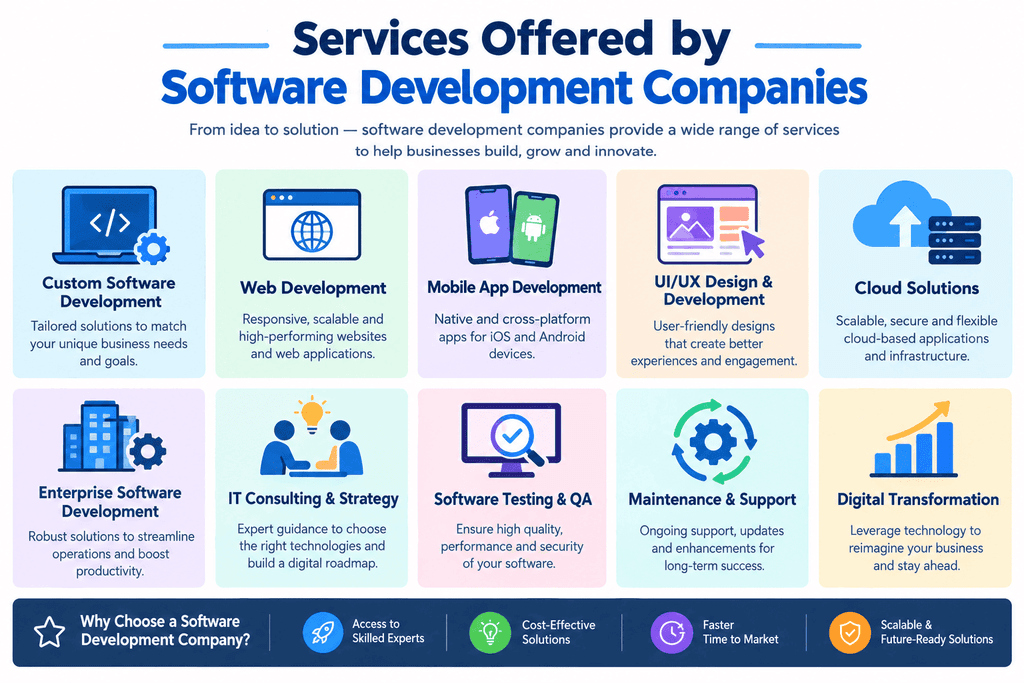
A professional software development company can provide a complete range of services throughout the software lifecycle.
Software Consulting
Software consulting helps businesses determine which technologies and development strategies are appropriate for their projects.
Consultants can analyze business requirements, identify technical challenges, recommend suitable technologies, and develop a roadmap for implementation.
UI/UX Design
User interface and user experience design play an important role in software success.
Designers create intuitive layouts, navigation systems, prototypes, and interactive interfaces that make applications easier and more enjoyable to use.
Custom Software Development
Custom software development involves building an application according to the client’s specific business requirements.
The development team creates the required frontend, backend, database, APIs, integrations, and other components.
Mobile Application Development
Mobile app development focuses on creating applications for smartphones and tablets.
Developers can build native applications or cross-platform solutions depending on the project’s requirements and target audience.
Web Application Development
Web application development involves creating browser-based software that users can access through the internet.
Examples include online marketplaces, customer portals, project management systems, booking platforms, and business dashboards.
Software Testing
Quality assurance teams test software to identify bugs, security issues, performance problems, usability concerns, and compatibility issues.
Testing may include functional testing, automated testing, performance testing, security testing, usability testing, and integration testing.
Software Maintenance
Software requires ongoing maintenance after launch. Development companies can provide bug fixes, security updates, performance improvements, infrastructure monitoring, and new feature development.
Benefits of Hiring a Software Development Company
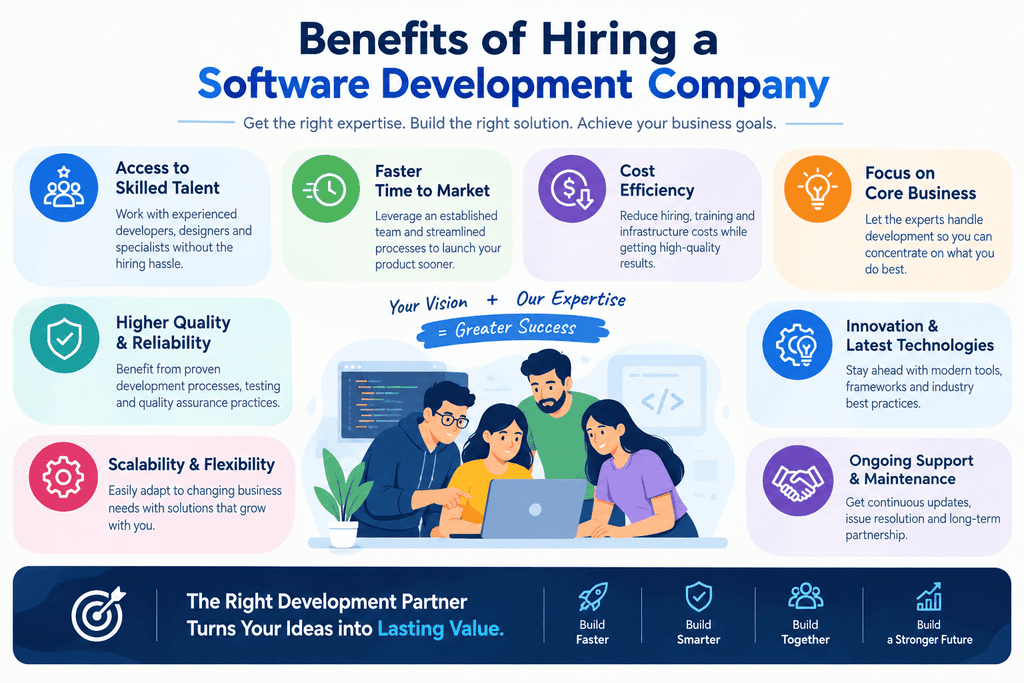
Access to Skilled Professionals
One of the major advantages is access to experienced software developers, designers, testers, architects, and project managers.
Instead of hiring a large internal team, businesses can work with an established development company that already has the necessary technical resources.
Faster Development
An experienced team can often develop software more efficiently because it has established development processes, tools, and expertise.
Proper planning and project management can also reduce unnecessary delays.
Cost Efficiency
Hiring a software development company can be more cost-effective than building and maintaining a large internal technology team, particularly for businesses that only need specialized expertise for specific projects.
The actual cost depends on project complexity, technology requirements, development location, team size, and timeline.
Scalability
Professional development companies can build software with future growth in mind.
A scalable application can support additional users, features, locations, transactions, and integrations as the business expands.
Access to Modern Technologies
Technology changes quickly. Development companies often work with modern frameworks, programming languages, cloud platforms, databases, and development tools.
This allows businesses to use current technologies without having to develop all of that expertise internally.
How to Choose the Best Software Development Company

Choosing the right software development partner requires careful research.
Check Their Portfolio
Review previous projects to understand the company’s development capabilities and experience.
Look for projects that are similar to your industry, business model, or technical requirements.
Evaluate Technical Expertise
Make sure the company has experience with the technologies required for your project.
Depending on your needs, this could include programming languages, mobile frameworks, cloud platforms, databases, APIs, artificial intelligence, cybersecurity, or enterprise systems.
Consider Industry Experience
Industry experience can be particularly valuable for projects involving complex workflows or regulatory requirements.
For example, healthcare software may require a different development approach from an e-commerce platform.
Read Client Reviews
Client reviews can provide insight into communication, reliability, project management, technical quality, and post-launch support.
However, businesses should consider multiple sources when evaluating a development company rather than relying on a single review.
Understand Their Development Process
Ask how the company handles requirements, design, development, testing, deployment, communication, and maintenance.
A clear development process can make projects easier to manage and reduce misunderstandings.
Evaluate Communication
Good communication is essential for successful software projects.
The development team should provide regular updates, explain technical decisions clearly, and respond to questions in a timely manner.
Ask About Post-Launch Support
Software development does not end when an application is launched.
Ask whether the company provides maintenance, technical support, security updates, performance monitoring, and future development services.
Software Development Technologies
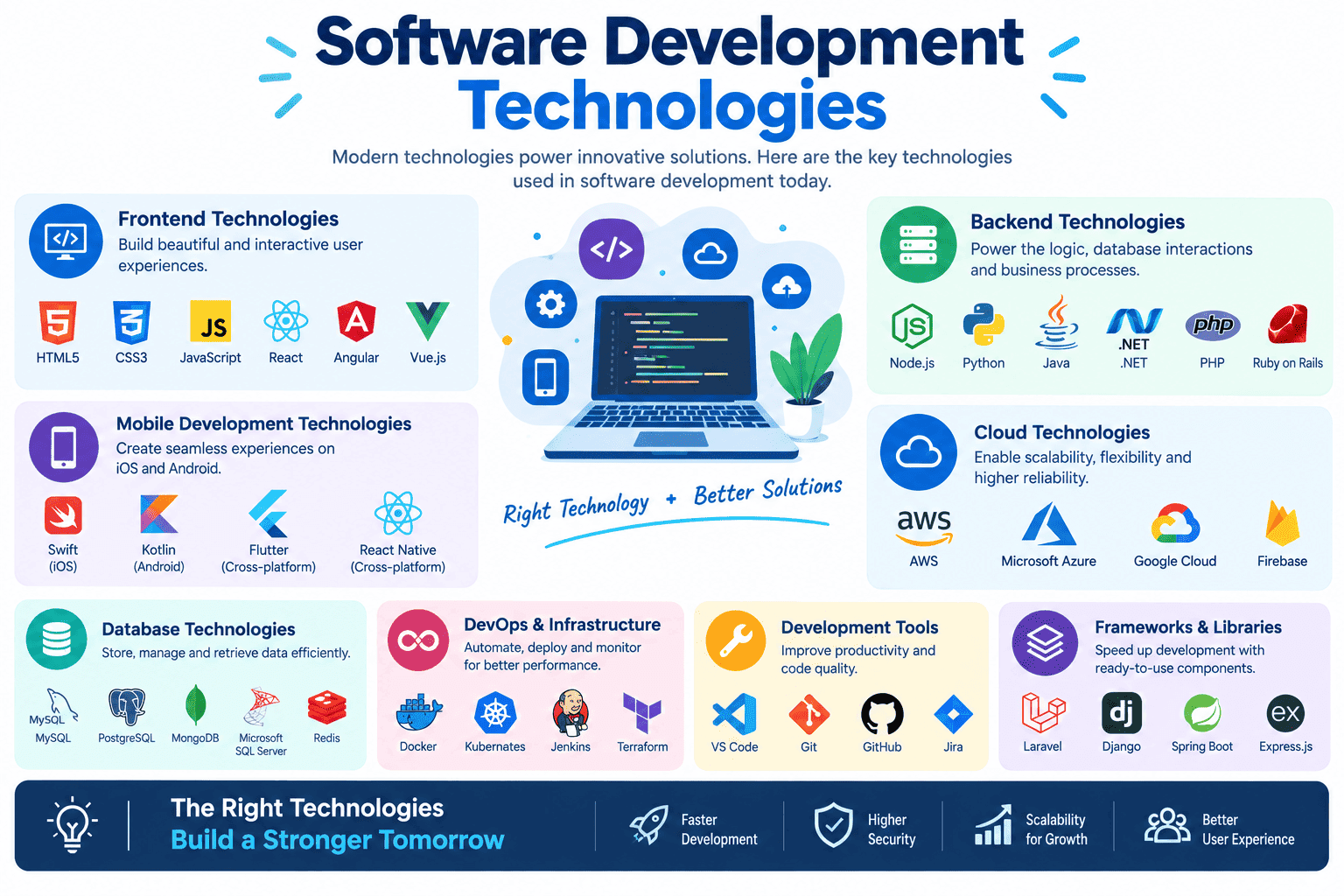
Software development companies use different technologies depending on project requirements.
Common technologies may include programming languages such as JavaScript, TypeScript, Python, Java, C#, PHP, Swift, and Kotlin.
Modern development may also involve frameworks and platforms such as React, Angular, Node.js, .NET, Flutter, React Native, and various cloud technologies.
Cloud platforms can provide scalable infrastructure, storage, databases, security services, monitoring, and deployment tools.
The right technology should be selected according to the project’s requirements rather than simply choosing the newest technology.
Software Development Process

A professional software development process usually includes several stages.
1. Requirement Analysis
The development team works with stakeholders to understand business goals, target users, required features, technical requirements, and project limitations.
2. Planning
The team creates a development roadmap, defines milestones, selects technologies, estimates resources, and establishes project priorities.
3. UI/UX Design
Designers create wireframes, prototypes, and interfaces based on user requirements.
4. Development
Developers build the software’s frontend, backend, database, APIs, and integrations.
5. Testing
Quality assurance specialists test the software to identify and resolve problems before launch.
6. Deployment
After testing and approval, the software is deployed to the appropriate production environment.
7. Maintenance
The development team continues to improve and maintain the software after launch.
Cost of Hiring Software Development Companies

The cost of software development varies from project to project.
Some of the main factors that affect development costs include:
- Project complexity
- Number of features
- Number of platforms
- Design requirements
- Development team size
- Technology stack
- Third-party integrations
- Security requirements
- Cloud infrastructure
- Development timeline
- Maintenance requirements
A simple application may require a relatively small development investment, while a complex enterprise platform can require a significantly larger budget.
Businesses should define their requirements before requesting estimates from development companies.
Future of Software Development
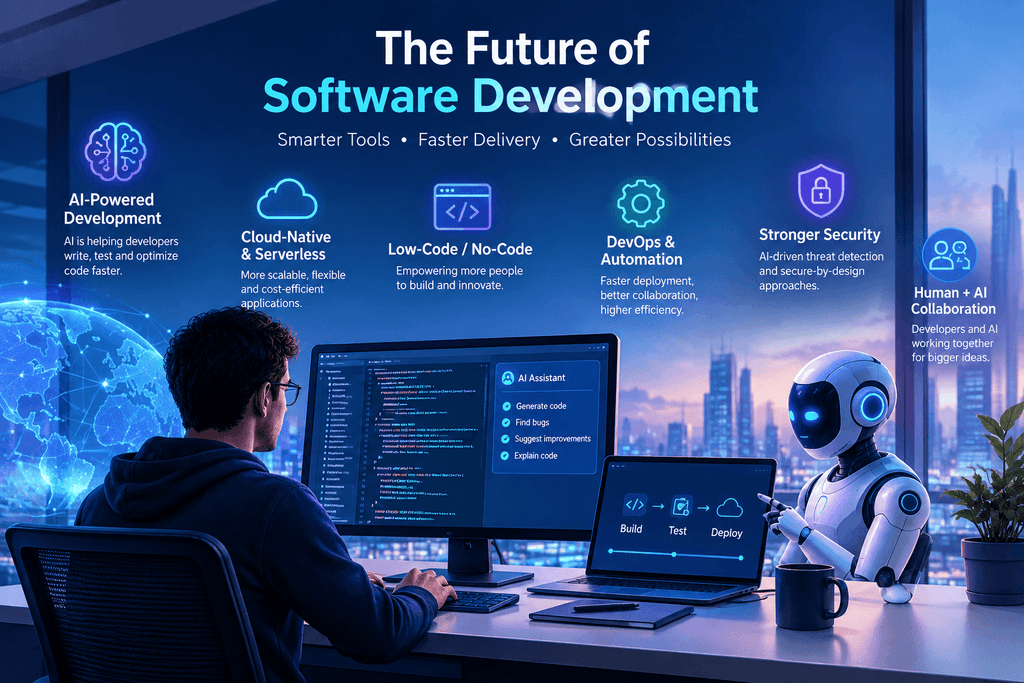
The software development industry continues to evolve as businesses adopt emerging technologies.
Artificial intelligence and machine learning are becoming increasingly important in software applications. Businesses are using AI for automation, data analysis, customer service, personalization, recommendation systems, and intelligent business processes.
Cloud computing is also transforming how applications are developed and deployed. Cloud-based infrastructure can provide flexibility, scalability, and access to a wide range of development and deployment services.
Low-code and automation technologies are also helping organizations build certain applications more quickly. However, complex and highly customized systems still often require professional software engineering expertise.
Cybersecurity will remain another major priority as businesses become increasingly dependent on digital platforms and connected systems.
Conclusion
Software development companies play an important role in helping businesses build and maintain modern digital solutions. From custom software and mobile applications to enterprise platforms, cloud solutions, and AI-powered systems, professional development teams can provide the expertise needed to transform business ideas into reliable software.
When choosing a software development company, businesses should consider technical expertise, industry experience, portfolio quality, communication, development processes, security practices, pricing, and post-launch support.
The right development partner can help an organization create software that is scalable, secure, user-friendly, and aligned with its long-term business goals. With the right planning and technology strategy, software can become a powerful tool for improving efficiency, strengthening customer relationships, and supporting sustainable business growth.
General & Selection Questions
Q1: How were the top software development companies in the USA ranked for 2026?
The 2026 rankings evaluate software engineering agencies based on verified client reviews, portfolio complexity, technical capabilities across modern stack environments, market reputation, client retention rates, and adherence to enterprise security standards.
Q2: What are the primary advantages of hiring a US-based software development company?
Partnering with a US-based software vendor offers direct working-hour overlap, strong cultural alignment with North American business models, seamless communication, strict compliance with US data laws (e.g., CCPA, HIPAA, SOC 2), and legally enforceable intellectual property (IP) protection.
Costs & Timelines
Q3: How much does it cost to hire a top software development company in the USA in 2026?
Hourly rates for top-tier US software engineering firms typically range from $100 to $250+ per hour. Total project investment ranges include:
- Minimum Viable Product (MVP) / Proof of Concept: $50,000 – $100,000
- Mid-Sized Enterprise Software: $100,000 – $350,000
- Complex Multi-Platform Systems: $350,000 – $1,000,000+
Q4: How long does custom software development take with a US agency?
Typical delivery timelines range between 4 and 12 months depending on scope:
- Discovery & Architecture Planning: 4 to 6 weeks
- Iterative Sprint Development: 12 to 24 weeks
- Testing, Security Audits & Deployment: 4 to 8 weeks
Methodologies & Quality Assurance
Q5: What software development methodologies do leading US agencies use?
Most top-ranked software companies follow Agile, Scrum, or DevOps frameworks. These methodologies break development into 2-to-4-week iterative sprints, allowing clients to see working code regularly, provide feedback, and pivot features without disrupting overall project milestones.
Q6: What technical services do full-service software development companies provide?
Premier US agencies provide end-to-end software engineering services, including:
- Custom web, cloud, and mobile application development
- Legacy system modernization and cloud migration (AWS, Azure, GCP)
- Enterprise system integrations and API development
- Quality assurance, automated testing, and security compliance (SOC 2, ISO 27001)
Ownership & Post-Launch Support
Q7: Who owns the intellectual property and code upon project completion?
You own 100% of the custom source code, design assets, and intellectual property. Top agencies include explicit IP transfer terms in their Master Services Agreements (MSAs) that assign full ownership to the client upon final payment.
Q8: What post-launch maintenance options do US software firms offer?
Top agencies offer structured Service Level Agreements (SLAs) for post-launch operations. These packages include 24/7 server performance monitoring, critical security patching, third-party API updates, bug resolution, and continuous feature optimization.