

Software development outsourcing has become an important strategy for businesses that want to build digital products without handling every development task internally. From startups creating their first application to established companies modernizing legacy systems, organizations increasingly work with external software development teams to access specialized skills, reduce development pressure, and accelerate project delivery.
Outsourcing can involve a single developer, a dedicated development team, or an entire software development company managing a project from planning through deployment. Depending on business requirements, companies can outsource web development, mobile applications, cloud solutions, artificial intelligence, cybersecurity, testing, maintenance, and other technical services.
However, successful outsourcing requires more than simply hiring a developer or development company. Businesses need to understand different outsourcing models, evaluate potential partners, establish clear requirements, and create effective communication processes. When managed properly, software development outsourcing can provide access to global talent while allowing internal teams to concentrate on their core business objectives.
What Is Software Development Outsourcing?

Software development outsourcing is the practice of hiring an external individual, development team, or software company to perform software-related work on behalf of a business. Instead of employing every technical specialist internally, an organization can contract an external provider for specific projects or ongoing development activities.
The outsourced team may be responsible for designing, developing, testing, deploying, and maintaining software. The exact responsibilities depend on the agreement between the client and service provider.
For example, a business may outsource the development of an e-commerce website while keeping marketing, sales, and customer support in-house. Another company may hire an external team to develop an entire mobile application, including user interface design, programming, testing, and cloud deployment.
Outsourcing can also be used for specialized technical requirements. A company with an existing development team might outsource cybersecurity testing, artificial intelligence development, DevOps, or quality assurance because these areas require specialized expertise.
The main idea is simple: businesses can obtain technical capabilities from outside organizations without building an entire development department internally.
Why Do Businesses Outsource Software Development?

There are several reasons organizations choose software development outsourcing. One of the most common is access to specialized technical talent. Finding experienced developers in areas such as cloud computing, machine learning, blockchain, cybersecurity, or mobile development can be difficult, particularly for businesses that do not operate in major technology markets.
Outsourcing also gives businesses access to a larger global talent pool. Instead of limiting recruitment to one city or country, companies can work with professionals from different regions.
Cost management is another consideration. Maintaining an internal development team involves salaries, recruitment, benefits, office infrastructure, equipment, training, and other expenses. Outsourcing can provide a more flexible way to obtain development resources, although the actual cost depends on project complexity, location, technology, and the outsourcing model.
Speed is also important. An established software development company may already have developers, designers, testers, project managers, and technical specialists available. This can allow a project to begin without spending months building a complete internal team.
Outsourcing can also allow internal employees to focus on their primary responsibilities. Instead of asking an internal marketing or operations team to manage technical development, the organization can rely on specialists while concentrating on business strategy and customer needs.
Common Software Development Outsourcing Models
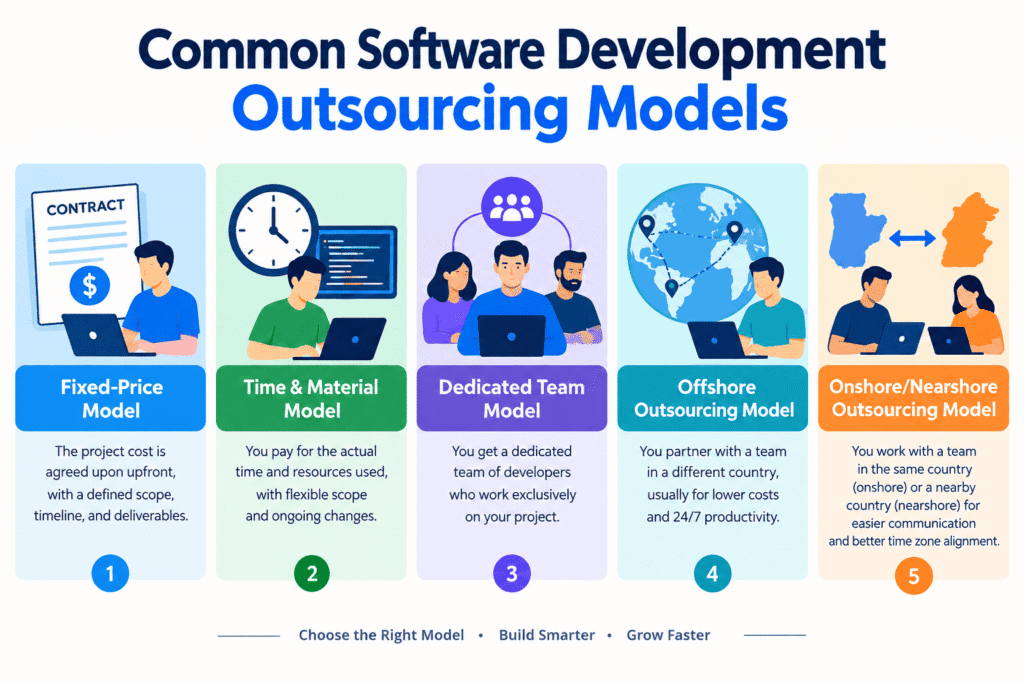
Businesses can choose from several outsourcing models depending on their project requirements and level of control.
Project-based outsourcing is suitable when the business has a clearly defined project with specific requirements, deadlines, and deliverables. The outsourcing provider manages development according to the agreed scope.
Dedicated development teams are useful for long-term projects or businesses that require continuous technical support. A dedicated team works primarily on the client’s project and can include developers, designers, testers, and project managers.
Staff augmentation involves adding external developers or specialists to an existing internal team. The company maintains control over project management while outsourced professionals provide additional technical capacity.
Another option is managed outsourcing, where an external provider takes responsibility for a larger portion of the development process. This can include planning, development, testing, deployment, maintenance, and technical support.
Companies may also choose outsourcing based on geographic location. Onshore outsourcing involves working with providers in the same country, while nearshore outsourcing typically involves nearby countries with similar or convenient time zones. Offshore outsourcing involves working with teams located farther away, often across different regions of the world.
The right model depends on budget, project complexity, desired control, communication requirements, and the expected duration of the relationship.
Benefits of Software Development Outsourcing

One major benefit of outsourcing is access to a wider range of technical skills. Businesses can find professionals experienced in specific programming languages, frameworks, cloud platforms, databases, and development methodologies.
Outsourcing can also increase flexibility. A company may need five developers during an intensive development period but only require limited technical support after launch. Working with an external provider can make it easier to adjust resources as requirements change.
Another benefit is faster access to development capabilities. Established providers often have development processes, project management systems, testing procedures, and technical infrastructure already in place.
Outsourcing can also support innovation. External teams may bring experience from working on different products and industries. Their knowledge can introduce businesses to new development approaches, tools, and technologies.
Businesses can also reduce some operational responsibilities. Recruitment, onboarding, technical training, and team expansion can require considerable time. Depending on the agreement, an outsourcing provider may handle many of these responsibilities.
However, outsourcing should not automatically be viewed as a way to guarantee lower costs or faster results. Poorly defined requirements, weak communication, or an unsuitable provider can create delays and additional expenses. The benefits depend heavily on how the outsourcing relationship is structured and managed.
Challenges and Risks of Software Development Outsourcing
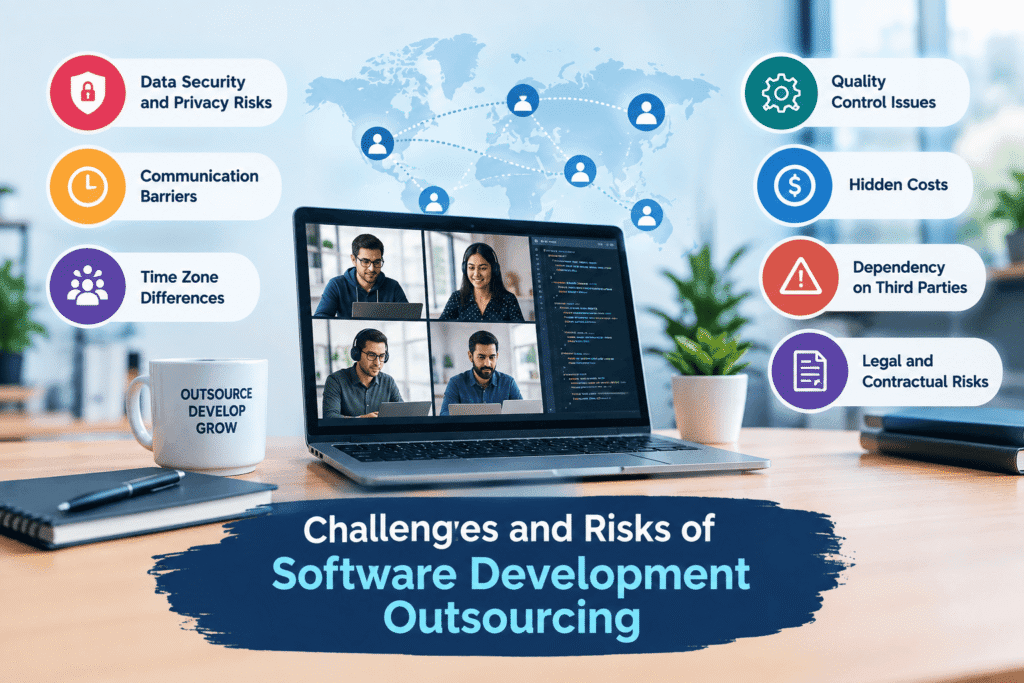
Although outsourcing offers many potential advantages, it also introduces challenges. Communication is one of the most important. Differences in language, communication styles, working hours, or expectations can create misunderstandings.
Time-zone differences can be particularly challenging when teams need frequent real-time discussions. Companies can reduce this problem by establishing overlapping working hours and using project management and communication platforms effectively.
Quality control is another concern. Businesses need to evaluate a provider’s technical capabilities before beginning a project. Reviewing previous work, technical expertise, development processes, client feedback, and testing practices can help identify suitable partners.
Data security and intellectual property protection are also important. Outsourced developers may have access to source code, databases, customer information, or internal systems. Businesses should establish appropriate security requirements, access controls, confidentiality agreements, and ownership terms.
Project scope can also become a problem. If requirements are unclear, additional features may continuously be added during development. This can increase both cost and delivery time. A clearly documented scope, development roadmap, and change-management process can reduce this risk.
Another challenge is dependency on an external provider. If important technical knowledge exists only with the outsourcing company, switching providers can become difficult. Businesses can reduce this risk through proper documentation, code ownership, knowledge transfer, and well-defined contractual agreements.
How to Choose a Software Development Outsourcing Company

Choosing the right outsourcing partner requires careful evaluation. Businesses should begin by defining their project requirements. This includes the desired software, target users, essential features, technology preferences, estimated timeline, budget, and expected outcomes.
Technical expertise should then be evaluated. Look for providers with experience in the technologies required for the project. A company developing a cloud-based application, for example, may need specialists in cloud infrastructure, backend development, databases, security, and DevOps.
A provider’s portfolio can offer useful information about its previous projects. Case studies may show how the company handled similar technical challenges and delivered solutions for other clients.
Communication processes should also be discussed before signing an agreement. Ask how frequently the team provides updates, which communication tools are used, who manages the project, and how technical issues are escalated.
Businesses should also clarify ownership and security. Contracts should clearly explain intellectual property rights, source-code ownership, confidentiality, data protection responsibilities, payment terms, and project deliverables.
It is also useful to start with a smaller engagement when appropriate. A pilot project can help both organizations understand each other’s communication styles, development processes, and expectations before entering a larger long-term relationship.
Best Practices for Successful Software Development Outsourcing

Successful outsourcing begins with clear communication. Businesses should provide detailed project requirements and explain the business problem the software is expected to solve. Development teams perform better when they understand both technical requirements and business objectives.
Project milestones should be established from the beginning. Instead of waiting until the end of a project to evaluate progress, teams should regularly review completed work and compare it with agreed requirements.
Agile development practices can be useful for projects where requirements may change. Short development cycles, regular demonstrations, feedback sessions, and continuous testing allow problems to be identified earlier.
Documentation should also be treated as an essential part of development. Technical architecture, APIs, deployment procedures, database structures, and important decisions should be documented so that knowledge does not remain with only one person or organization.
Security should be considered throughout the development lifecycle rather than only at the end. Access permissions, secure development practices, code reviews, vulnerability testing, backups, and monitoring can help protect software and data.
Businesses should also maintain a healthy working relationship with the outsourced team. External developers should be treated as professional partners rather than simply as temporary resources. Clear expectations, constructive feedback, mutual respect, and transparent communication can contribute to better collaboration.
The Future of Software Development Outsourcing

Software development outsourcing is likely to remain an important part of the global technology industry as businesses continue adopting cloud computing, artificial intelligence, automation, mobile applications, and digital platforms.
The outsourcing industry is also evolving. Businesses are increasingly looking for partners that can provide more than basic programming. Services may include product strategy, user experience design, cloud architecture, cybersecurity, artificial intelligence, DevOps, testing, and long-term technical support.
Remote work has also expanded the possibilities for distributed software teams. Companies can collaborate with developers across different countries while using cloud-based development environments, project management platforms, video conferencing, and collaboration tools.
Artificial intelligence is another factor changing software development. AI-assisted coding and automated testing can improve developer productivity, but businesses still need experienced professionals who understand architecture, security, business requirements, and software quality.
For companies considering outsourcing, the goal should not simply be to find the cheapest development provider. A successful partnership depends on technical capability, communication, security, transparency, and a shared understanding of business objectives.
When these elements are carefully managed, software development outsourcing can help businesses access specialized talent, increase flexibility, accelerate digital initiatives, and develop technology without building every capability internally. The most effective outsourcing relationships are built around clear goals, strong collaboration, and long-term value.
Conclusion
The future of software development outsourcing is focused on global collaboration, advanced technologies, faster development, and flexible business solutions. As companies continue to adopt cloud computing, artificial intelligence, and remote development models, outsourcing can help businesses access specialized talent and build software more efficiently. Choosing the right outsourcing partner, maintaining clear communication, and focusing on security and quality can help businesses achieve long-term success in a rapidly changing technology landscape.
Frequently Asked Questions
Which job boards host the highest-paying remote software engineering roles in 2026?
Top-tier compensation—including high base salaries, equity, and performance bonuses—is primarily concentrated on platforms with strict listing filters, direct founder access, or rigorous candidate vetting:
- Levels.fyi & Built In: Ideal for searching specifically by total compensation (TC), salary transparency, and equity packages.
- Wellfound (formerly AngelList) & Y Combinator’s “Work at a Startup”: Best for high-equity startup roles (Series A to pre-IPO) with competitive pay structures.
- Hacker News (“Who is Hiring?”): A monthly high-signal thread where engineering leads and founders post directly, often omitting middle-man recruiters and offering upper-bracket pay.
- Toptal & Arc.dev: Best for senior contract and freelance engineers looking for high hourly or daily rates.
Do “worldwide remote” jobs actually pay US-level Silicon Valley salaries?
Yes, but it depends on the hiring company’s compensation philosophy. Companies are generally split into two compensation models:
- Location-Independent (Global Pay): Companies like GitLab and Basecamp pay based on the value of the role, offering top-tier US rates regardless of where you live.
- Location-Adjusted (Tiered Pay): Many US and EU companies benchmark compensation against local cost-of-living tiers.
To target top-dollar global roles, use platforms like TrulyRemoteWork or filter explicitly for “Worldwide / Location Agnostic” on Himalayas and Remotive.
What technical stacks command the highest remote salaries in 2026?
High compensation closely tracks specialization, system scale, and high-impact business needs:
- AI & Machine Learning Infrastructure: Engineers working on LLM fine-tuning, inference optimization, vector databases, and MLOps.
- Systems & Low-Level Engineering: Rust, Go, and C++ for distributed systems, cloud infrastructure, and low-latency platforms.
- Data Engineering & Analytics Infrastructure: Snowflake, Databricks, and large-scale data pipeline architecture.
- Security & Cloud DevOps: Distributed cloud security, Kubernetes architecture, and Site Reliability Engineering (SRE).
How can I bypass standard application tracking systems (ATS) on remote job boards?
High-paying remote roles receive hundreds of applications within hours. To increase your odds:
- Apply Direct & Fast: Monitor monthly threads like Hacker News’ Who is Hiring? on the 1st of every month to submit applications directly to engineering managers.
- Leverage Network-First Platforms: Use Wellfound to message founders directly alongside your application.
- Build a Public Proof-of-Work: Active GitHub contributions, technical write-ups, or open-source maintenance carry significantly more weight than a traditional resume for upper-tier remote positions.
What experience level is required to land high-paying remote roles?
While mid-level developers can land well-paying remote jobs, roles paying in the top 10% of the market overwhelmingly target Senior, Staff, and Principal Engineers (5+ years of experience). These roles require minimal supervision, strong asynchronous communication skills, and proven experience managing system architecture remotely.