
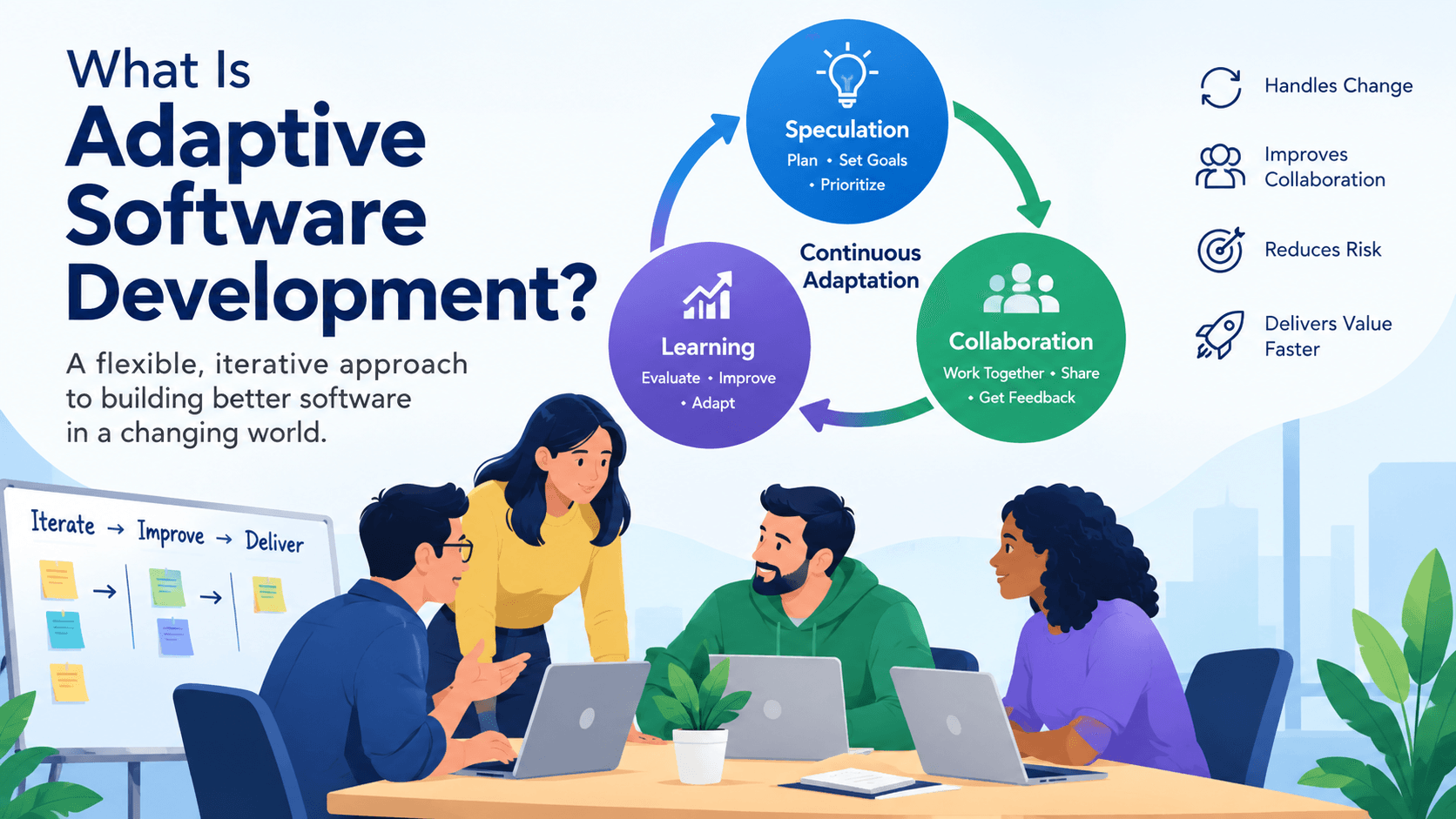
Software development has changed significantly over the years. Businesses today need applications that can respond quickly to changing customer expectations, new technologies, market conditions, and business requirements. Traditional development methods can sometimes struggle when requirements change frequently. This is where adaptive software development becomes useful.
Adaptive software development is an approach that focuses on flexibility, continuous learning, collaboration, and the ability to respond to change. Instead of assuming that every project requirement can be perfectly predicted at the beginning, this approach accepts that software projects often evolve during development.
In this article, we will explain what adaptive software development means, how it works, its main principles, benefits, challenges, and how it compares with traditional development approaches.
What Is Adaptive Software Development?

Adaptive software development is a flexible software development methodology designed for projects where requirements, technologies, and business needs may change during the development process.
The approach encourages development teams to learn from each development cycle and use that information to improve the next one. Rather than following a completely fixed plan, teams continuously evaluate progress, collect feedback, and make adjustments.
The main idea is simple: software development should be able to adapt to change instead of resisting it.
This makes the methodology particularly useful for modern software projects involving complex requirements, innovative technologies, startups, web applications, artificial intelligence, and products where customer feedback can significantly influence the final solution.
How Does Adaptive Software Development Work?
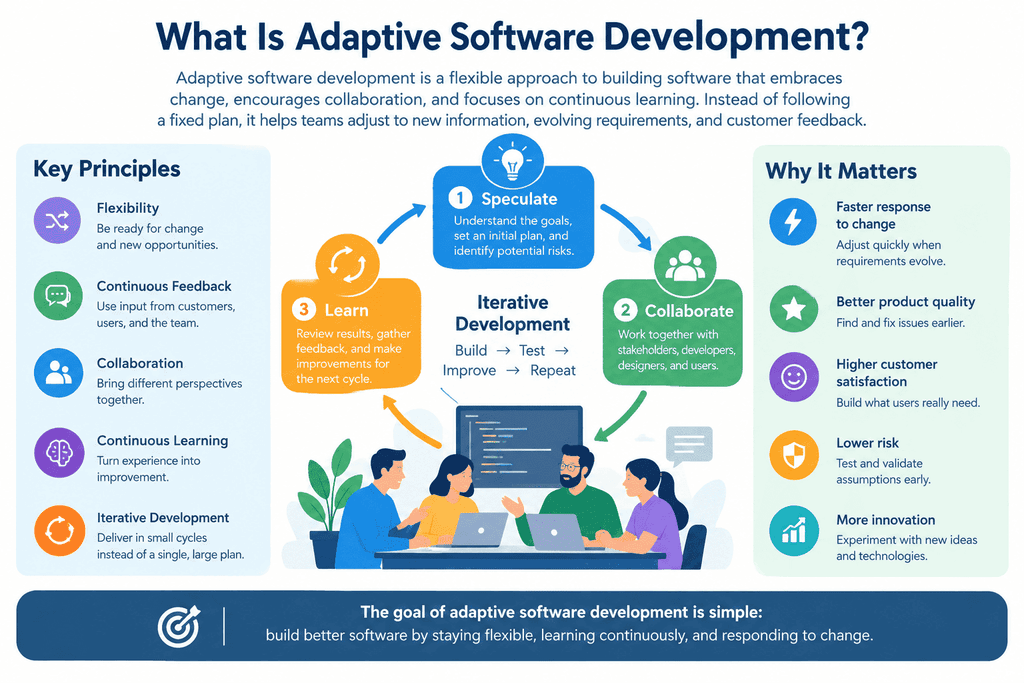
Adaptive software development generally follows an iterative process. Instead of trying to build the entire application according to a fixed plan, developers divide the work into smaller cycles.
These cycles allow teams to build, test, evaluate, and improve software continuously.
The process is commonly associated with three important activities:
1. Speculate
The first stage involves creating an initial understanding of the project. The team identifies goals, expected features, possible risks, and an initial development plan.
However, the plan is not treated as permanent. It provides direction while leaving room for changes.
For example, a company may want to create an e-commerce application. The initial plan could include product listings, shopping carts, user accounts, and payment functionality. During development, customers might provide feedback suggesting additional features.
The team can then adjust its priorities based on what it learns.
2. Collaborate
The second stage focuses on teamwork and communication.
Developers, designers, project managers, business stakeholders, testers, and customers may need to work together to solve problems and make decisions.
Collaboration is important because different team members bring different perspectives. A developer may understand technical limitations, while a customer may understand user expectations better.
Effective communication helps the team make better decisions and respond quickly when circumstances change.
3. Learn
Learning is one of the most important parts of the process.
After completing an iteration, the team reviews what worked, what failed, and what could be improved. Testing results, customer feedback, performance data, and team experiences can all contribute to this learning process.
The lessons learned are then used during the next development cycle.
This creates a continuous improvement loop in which every iteration provides information that can make the product better.
Key Principles of Adaptive Software Development

Several principles make this approach different from rigid development methodologies.
Flexibility
Flexibility is at the center of the methodology. Developers understand that requirements may change and prepare the development process accordingly.
Instead of considering changes a failure of planning, the team treats them as opportunities to improve the software.
Continuous Feedback
Regular feedback helps teams understand whether they are moving in the right direction.
Feedback can come from customers, users, testers, managers, analytics, or other stakeholders. Early feedback can prevent teams from spending months developing features that users do not actually need.
Collaboration
Successful software projects require cooperation between technical and non-technical people.
Teams that communicate frequently can identify problems earlier, share ideas, and make decisions more efficiently.
Continuous Learning
Developers should learn from every iteration. A failed experiment, unexpected technical problem, or negative customer response can provide valuable information.
Learning allows the team to make better decisions as the project progresses.
Iterative Development
Instead of delivering everything at the end, software is developed through repeated cycles.
Each cycle can produce improvements, new features, fixes, or validated ideas.
Benefits of Adaptive Software Development
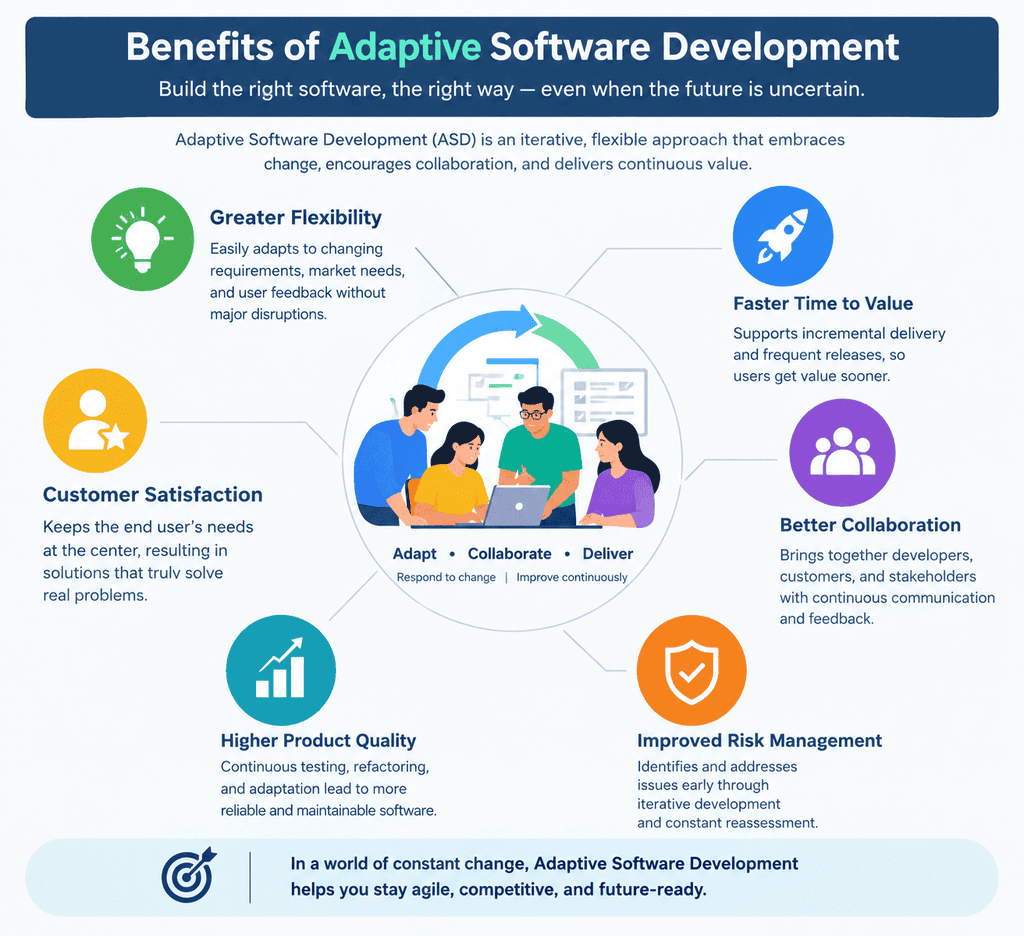
This methodology can provide several advantages for modern software teams.
1. Faster Response to Change
One of the biggest advantages is the ability to respond quickly when requirements change.
For example, if a competitor launches a new feature, a business may need to adjust its product strategy. A flexible development process makes such changes easier to accommodate.
2. Better Product Quality
Frequent testing and feedback can help identify problems earlier.
Instead of discovering major issues near the end of a project, developers can detect and fix problems during smaller development cycles.
3. Improved Customer Satisfaction
Customers are more likely to be satisfied when their feedback is considered throughout development.
They can see progress, provide suggestions, and influence the direction of the product.
4. Reduced Development Risk
Large projects often involve uncertainty. Teams may not know exactly how a new technology will perform or how users will respond to a feature.
Iterative development allows teams to test assumptions early, reducing the risk of making expensive decisions based on incorrect expectations.
5. Better Team Collaboration
Frequent communication encourages developers, designers, testers, and stakeholders to work toward shared goals.
This can reduce misunderstandings and improve project transparency.
6. Greater Innovation
Flexible development encourages experimentation. Teams can test new technologies, design concepts, and features without committing the entire project to an untested idea.
This can be especially valuable for innovative software products.
Adaptive Software Development vs Traditional Development

Traditional software development models often rely on detailed planning before development begins. The requirements are documented, the project is planned, and development follows a structured sequence.
This approach can work well when requirements are stable and predictable.
However, some modern projects operate in uncertain environments. Customer preferences may change, competitors may introduce new products, and technologies can evolve quickly.
A flexible development approach handles these conditions differently.
| Feature | Adaptive Approach | Traditional Approach |
|---|---|---|
| Requirements | Can change frequently | Usually defined early |
| Planning | Flexible and evolving | More detailed upfront |
| Feedback | Continuous | Often occurs at specific stages |
| Development | Iterative | Often sequential |
| Change | Expected | May require formal changes |
| Customer involvement | Frequent | Can be limited |
| Learning | Continuous | Often concentrated in reviews |
Neither approach is automatically better for every project. The right choice depends on project requirements, business goals, risk levels, team structure, and the amount of uncertainty involved.
When Should You Use This Approach?
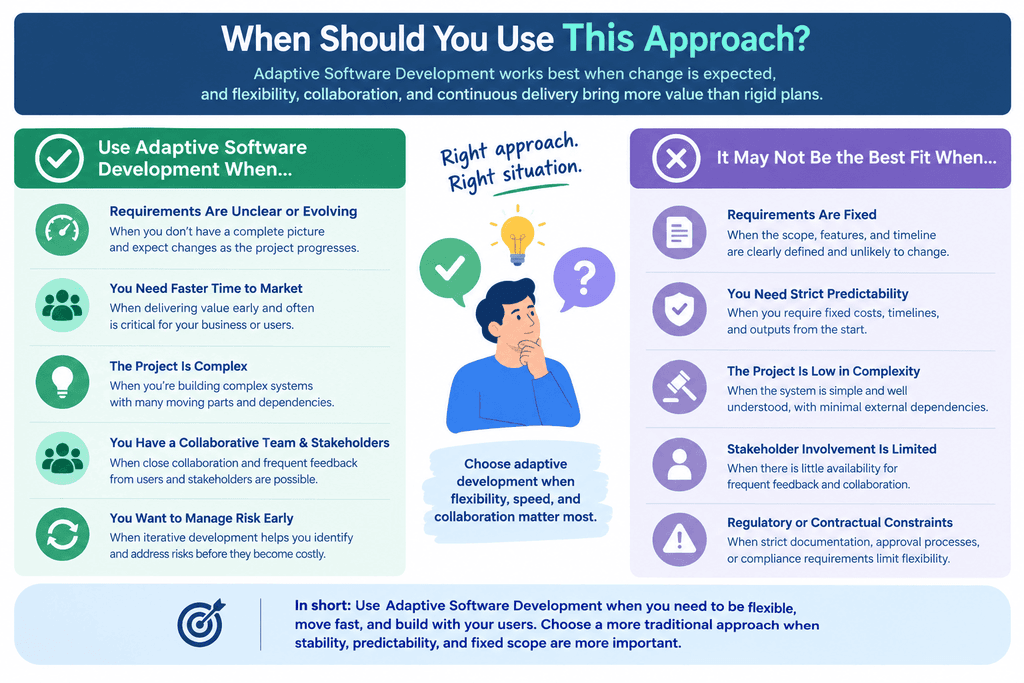
Adaptive development can be particularly useful when a project has uncertain or changing requirements.
It may be suitable for:
- Startup software products
- Mobile applications
- Web applications
- Artificial intelligence projects
- Machine learning systems
- Cloud-based platforms
- E-commerce applications
- Experimental software
- Customer-focused products
- Projects using new technologies
For example, an AI application may require frequent adjustments because developers are still learning how users interact with the system. A rigid plan created at the beginning may become outdated quickly.
A flexible development process allows the team to respond to new information.
Challenges of Adaptive Software Development
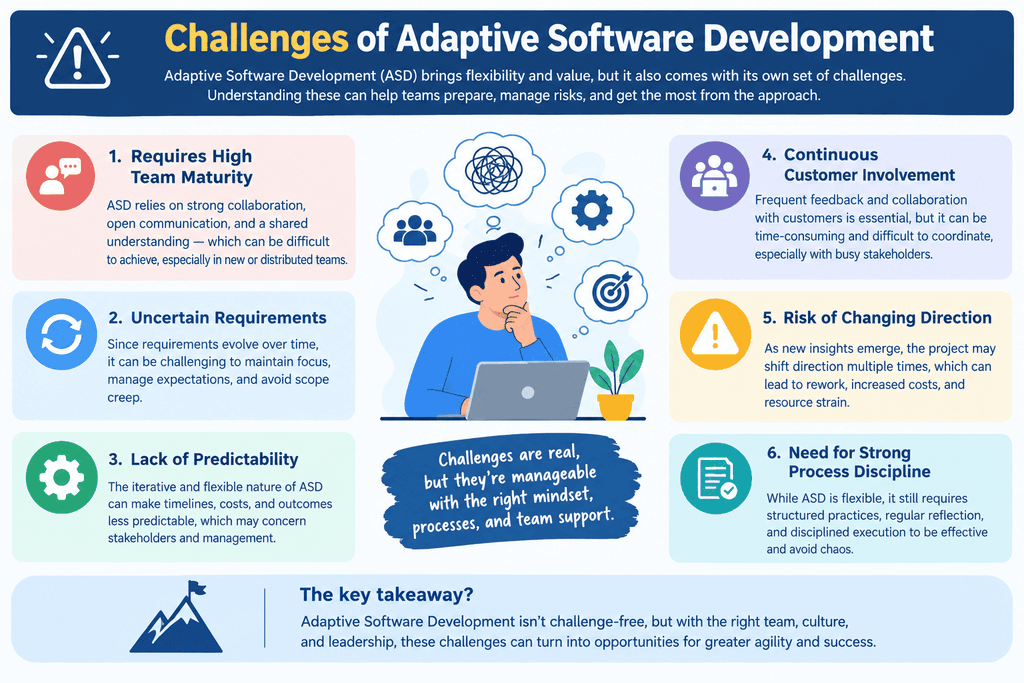
Although this methodology offers many advantages, it also presents challenges.
Changing Requirements
Frequent changes can create confusion if they are not properly managed. Teams need clear priorities to prevent constant changes from delaying the project.
Difficult Planning
Long-term planning can be more difficult because future requirements are uncertain.
Organizations may need to estimate budgets, schedules, and resources while accepting that some details will change.
Communication Requirements
The approach depends heavily on communication. If team members do not communicate effectively, important feedback may be missed.
Requires Experienced Teams
Teams need to be comfortable making decisions in uncertain situations. Developers and managers must be willing to learn, experiment, and adjust plans.
Scope Management
Flexibility does not mean accepting every requested feature. Teams must carefully evaluate changes and decide which ones provide real value.
Role of Customer Feedback
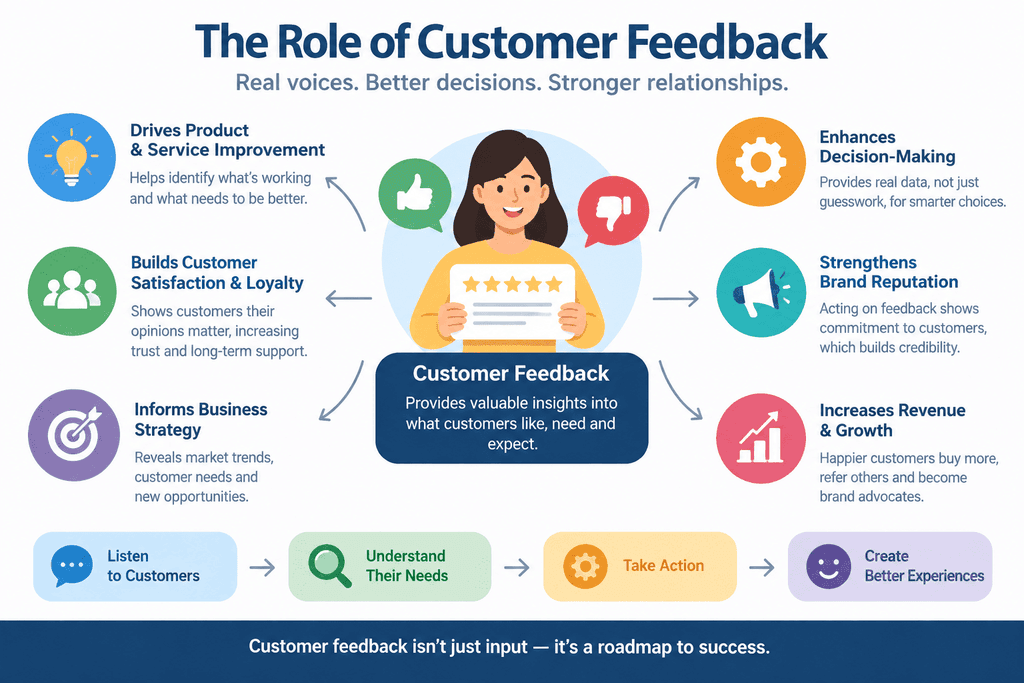
Customer feedback plays a major role in flexible software development.
A development team may have assumptions about what users want, but actual users can provide information that challenges those assumptions.
For example, a team might spend several weeks developing an advanced dashboard. After testing, users may report that the dashboard is difficult to understand and that they would prefer a simpler interface.
Instead of continuing with the original plan, the team can use this feedback to redesign the feature.
This process helps create software based on real-world needs rather than assumptions alone.
Adaptive Development and Agile
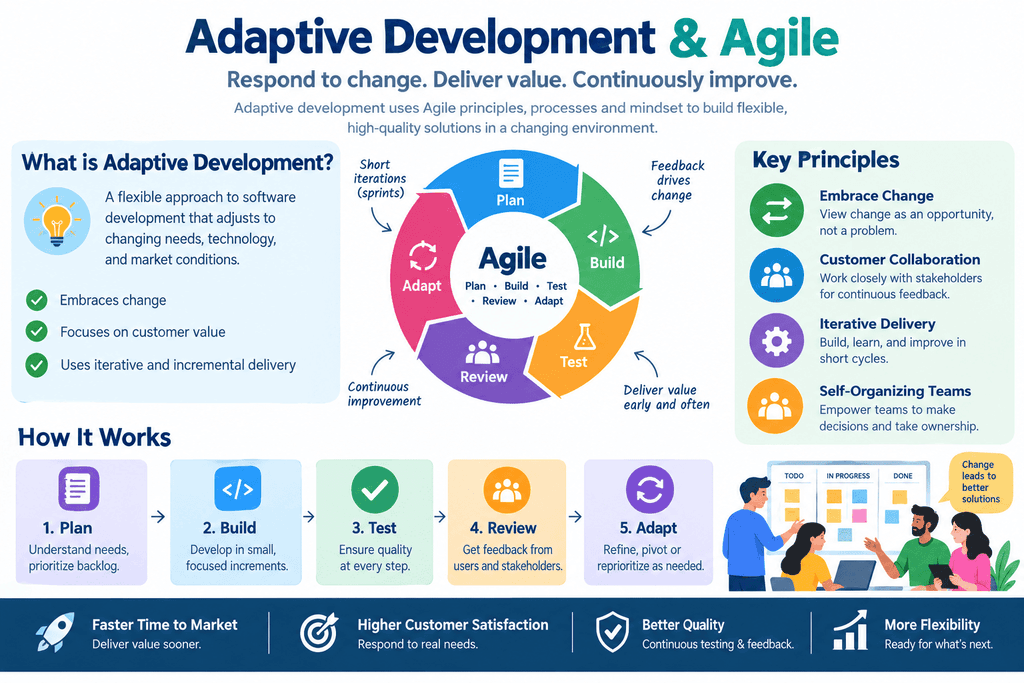
Adaptive software development is closely related to Agile principles.
Agile development promotes iterative development, customer collaboration, continuous feedback, and responsiveness to change. Adaptive methods share many of these ideas.
However, adaptive development places particular emphasis on dealing with uncertainty and learning as the project progresses.
Agile frameworks and practices can therefore support an adaptive development environment. Teams may use short iterations, regular reviews, continuous testing, and customer feedback to make their development process more responsive.
Best Practices for Successful Implementation

Organizations can improve their results by following several best practices.
First, establish clear project goals. Flexibility works better when the team understands the overall purpose of the product.
Second, communicate regularly. Developers and stakeholders should have frequent opportunities to discuss progress, problems, and changes.
Third, prioritize requirements. Not every new request should automatically become part of the product.
Fourth, test early and often. Early testing provides useful information and reduces the chance of discovering serious problems later.
Finally, document important decisions. Although the process is flexible, teams still need enough documentation to understand why major decisions were made.
Future of Adaptive Software Development
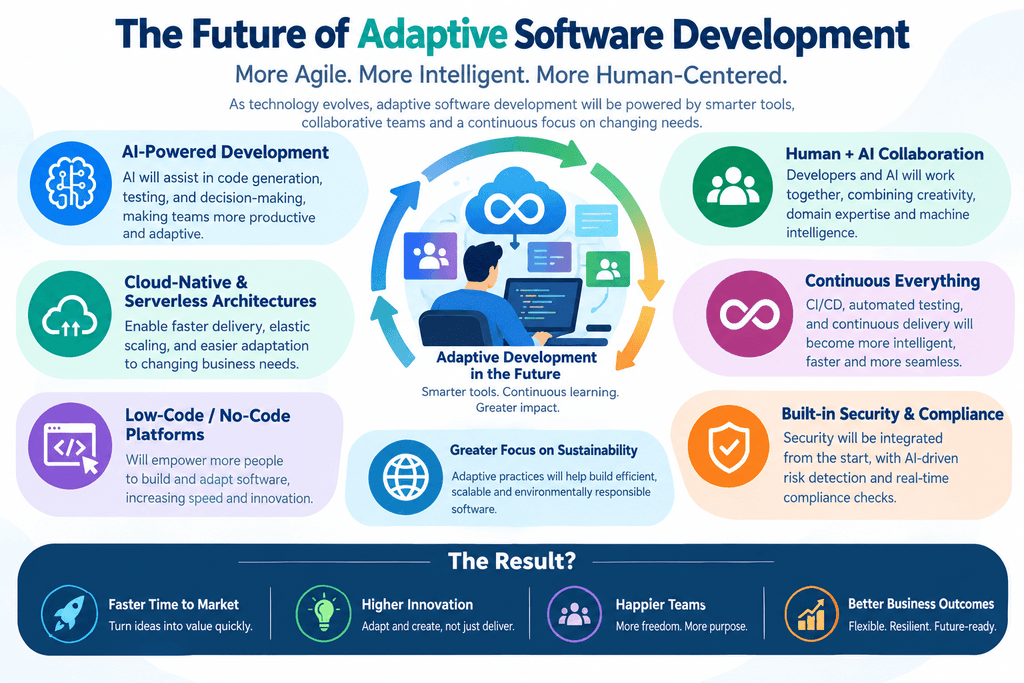
The demand for flexible software development is likely to continue as technology evolves.
Artificial intelligence, cloud computing, automation, cybersecurity, Internet of Things devices, and other emerging technologies create environments where requirements can change quickly.
Businesses also expect software teams to deliver useful products faster. Customers increasingly expect applications to improve continuously rather than remain unchanged for years.
These trends make adaptability an important capability for modern development teams.
Conclusion
Adaptive software development provides a flexible way to build software in environments where uncertainty and change are common. Its focus on speculation, collaboration, learning, iteration, and feedback allows teams to adjust their plans as they gain new information.
Unlike rigid development approaches that may depend heavily on fixed requirements, this methodology accepts that software projects can evolve. Teams can learn from customers, testing, experiments, and real-world results and use that knowledge to improve the product.
The approach is especially useful for innovative applications, startups, AI projects, web platforms, and other products where requirements may not be completely understood at the beginning.
Ultimately, successful software development is not only about following a plan. It is also about knowing when to change that plan. By creating a development process that welcomes learning and controlled change, organizations can build software that is more useful, responsive, and aligned with real user needs.
Core Concepts & Definition
Q1: What is Adaptive Software Development (ASD)?
Adaptive Software Development (ASD) is an Agile-aligned software development framework created by Jim Highsmith and Sam Bayer. Built specifically for complex, fast-changing projects, ASD operates on the principle that continuous adaptation—rather than rigid static planning—is essential to delivering successful software in unpredictable environments.
Q2: What are the three core phases of the ASD lifecycle?
Unlike traditional linear models, ASD replaces rigid plan-design-build steps with a continuous cycle:
- Speculate: Defining the overall project mission, setting baseline constraints, and scheduling iterative release cycles without locking down exact feature details.
- Collaborate: Bringing together cross-functional developers, domain experts, and business stakeholders to solve unexpected technical challenges.
- Learn: Evaluating working software through rapid user testing, stakeholder feedback, and post-mortems to guide the next iteration.
ASD vs. Agile
Q3: How does Adaptive Software Development compare to general Agile?
Agile is an umbrella philosophy that emphasizes flexibility, collaboration, and iterative delivery. ASD is a specific framework within the Agile ecosystem. While Agile focuses broadly on cross-functional team dynamics and customer satisfaction, ASD specifically targets high-uncertainty environments by replacing predictable project management with dynamic adaptation mechanisms (Speculate $\rightarrow$ Collaborate $\rightarrow$ Learn).
Q4: How does ASD differ from Scrum?
- Scrum: Uses prescribed roles (Scrum Master, Product Owner), specific ceremonies (Daily Standup, Sprint Retrospective), and fixed-length sprints (usually 2–4 weeks).
- ASD: Focuses more on organizational mindset, constant evolution, and managing systemic complexity rather than following rigid roles or prescribed meeting structures.
Benefits & Best Practices
Q5: What are the main benefits of using Adaptive Software Development?
- Rapid Adaptation: Allows teams to pivot seamlessly when customer requirements, market conditions, or tech stacks shift unexpectedly.
- Faster Time-to-Market: Delivers functional, high-value software components early and often.
- Higher End-User Satisfaction: Frequent feedback loops ensure the final product reflects actual user needs rather than outdated initial specs.
Q6: What are the main challenges of implementing ASD?
- Risk of Scope Creep: Without clear boundaries, continuous adaptation can lead to expanding feature sets and bloated budgets.
- High Stakeholder Demand: Requires active, ongoing participation from business stakeholders during the Learn phase.
- Requires Senior Talent: Thrives best with self-disciplined, highly skilled developers comfortable working in fluid, self-organizing teams.
Use Cases
Q7: When should a product team choose ASD over traditional development methods?
ASD is ideal for projects facing high market volatility, emerging technologies (such as AI integration), or fast-moving markets where traditional up-front planning is impractical or likely to become obsolete.